A research team led by Prof. Peiyuan QIAN has made significant progress in understanding how deep-sea chemosynthetic symbioses cope with environmental change. By combining deep-sea in situ transplantation experiments with multi-omics, molecular, and cellular approaches, the team has uncovered a tiered adaptation strategy that enables a chemosynthetic clam and its symbionts to cope with fluctuations in hydrogen sulfide availability. The findings show that metabolic plasticity in the symbionts, together with the host's dynamic regulation of its symbiont population, can help maintain the energy balance of the holobiont under changing environmental conditions. The study provides important in situ evidence for how deep-sea chemosynthetic holobionts maintain resilience when energy supplies fluctuate and highlights the importance of tiered adaptation in sustaining the stability of cold seep ecosystems. The findings were recently published in the leading international journal Science Advances under the title “In situ evidence of tiered adaptations buffering a chemosynthetic clam holobiont against environmental sulfide fluctuations.”
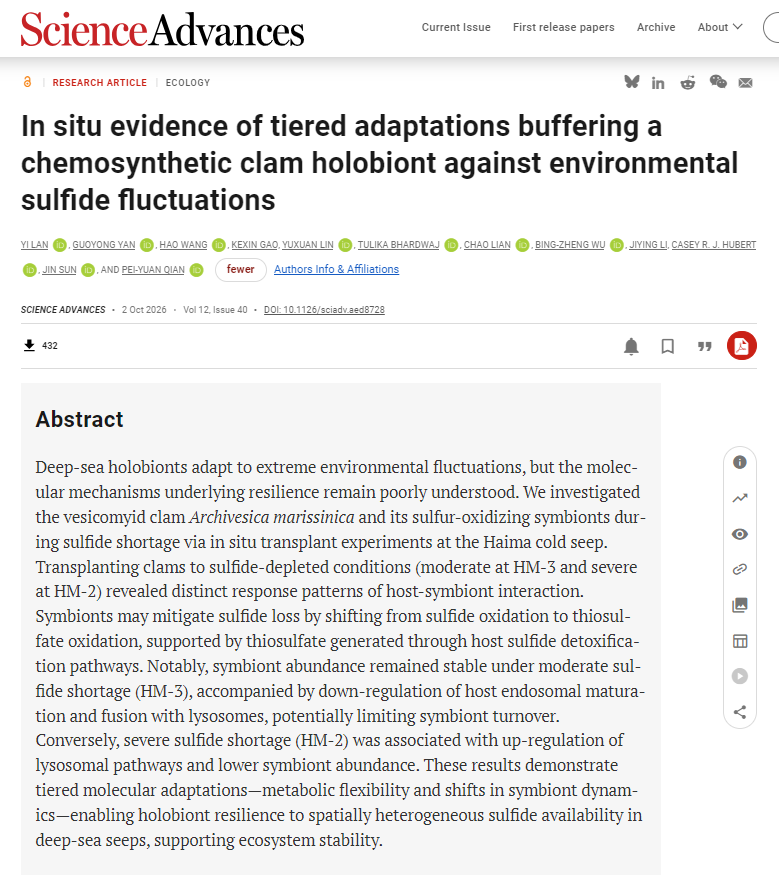
Deep-sea hydrothermal vents and methane seeps are among the most distinctive ecosystems in the ocean, where biological communities are sustained not primarily by sunlight but by chemical energy. Hydrogen sulfide is an important energy source for many chemosynthetic symbioses, yet its availability can fluctuate substantially in response to tectonic activity, seepage intensity, and biogeochemical processes such as anaerobic oxidation of methane in sediments. How deep-sea symbiotic organisms cope with these fluctuations, and how hosts and symbionts coordinate their responses to maintain physiological and ecological stability, has remained poorly understood, largely because direct experimental manipulation under natural deep-sea conditions is extremely challenging.
The Haima cold seep in the South China Sea contains seep sites at different stages of development, providing a natural laboratory for investigating how deep-sea organisms respond to environmental change. The research team focused on the vesicomyid clam Archivesica marissinica, a dominant species at the Haima cold seep, and its sulfur-oxidizing bacterial symbionts. The researchers conducted in situ transplantation experiments at two seep sites, HM-3 and HM-2, by transferring clams from their native sediment into transplantation cages positioned approximately 0.5 meters above the seafloor. This prevented the clams from directly accessing hydrogen sulfide-rich sediments and thereby simulated a reduction in hydrogen sulfide availability and associated energy and nutrient acquisition. The two sites represented different degrees of environmental stress, with HM-3 corresponding to relatively moderate hydrogen sulfide limitation and HM-2 representing more severe limitation. By integrating metagenomics, transcriptomics, proteomics, quantitative PCR, in situ hybridization, transmission electron microscopy, and protein structure prediction, the team was able to investigate the responses of the holobiont across multiple biological levels, from symbiont metabolism and host regulation to resource transport.

Figure 1. Deep-sea in situ transplant experiments corresponding to moderate (HM-3) and severe (HM-2) sulfide depletion.
The results revealed that reduced hydrogen sulfide availability first triggered pronounced metabolic reprogramming in the bacterial symbionts. Transcriptomic and proteomic analyses showed that pathways involved in sulfide oxidation, including dsrAB, aprAB, and sat, were suppressed, whereas the soxXYZ gene cluster associated with thiosulfate oxidation was upregulated. These changes indicate that when hydrogen sulfide becomes limiting, the symbionts can adjust their sulfur-oxidation strategy and potentially increase their capacity to utilize thiosulfate, thereby helping to sustain energy metabolism and carbon fixation. Such metabolic plasticity may represent an early line of defense that allows the holobiont to buffer short-term fluctuations in its primary energy supply.
The study further showed that the host dynamically regulates its symbionts according to the severity of environmental stress. Under the relatively moderate hydrogen sulfide limitation at HM-3, symbiont abundance remained stable, while pathways associated with endosomal maturation and endosome–lysosome fusion were suppressed. This suggests that the host may reduce intracellular degradation and turnover of symbionts, thereby prioritizing the maintenance of the symbiotic population when resources become moderately constrained. Under the more severe hydrogen sulfide limitation at HM-2, however, symbiont abundance decreased significantly, and transmission electron microscopy revealed lysosome-mediated digestion of symbionts. These observations suggest that under severe resource limitation, the host may increase symbiont turnover and recover nutrients from symbiont biomass, providing an additional strategy for maintaining host survival. Together, these findings indicate that the host does not simply maintain or eliminate its symbionts, but instead adjusts the balance between symbiont retention and turnover according to the intensity of environmental stress.
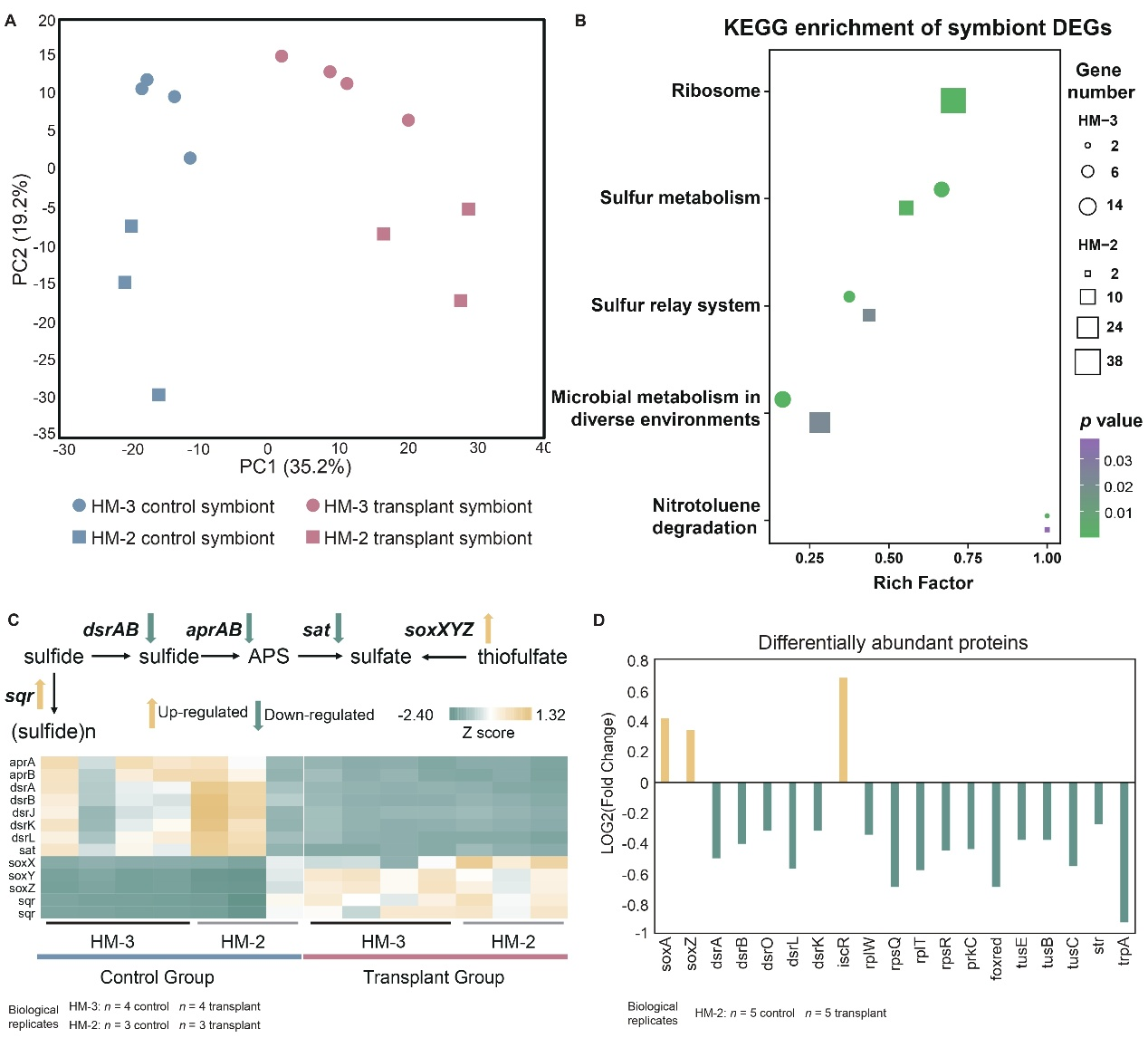
Figure 2. Symbiont gene expression and protein abundance changes in response to different degrees of sulfide depletion
The researchers also identified a potential metabolic link between host detoxification and symbiont energy acquisition. The gill tissue of A. marissinica showed strong sulfur-metabolic capacity and high expression of key enzymes including thiosulfate sulfurtransferase (TST), which participates in the conversion of toxic hydrogen sulfide into thiosulfate. Because thiosulfate can subsequently be utilized by sulfur-oxidizing bacteria, and because the symbiotic soxXYZ gene cluster was upregulated under hydrogen sulfide limitation, the results suggest that thiosulfate generated during host sulfide detoxification may serve as an alternative sulfur substrate for the symbionts. This points to a potential “host detoxification–symbiont utilization” metabolic linkage, in which a host physiological process that reduces sulfide toxicity may simultaneously provide the symbionts with an alternative energy resource. Such metabolic complementarity may contribute to the stability of the holobiont under resource-limited conditions.
The team also investigated the potential role of hemoglobins in the transport of gases within A. marissinica. The two hemoglobin subunits, Hb1 and Hb2, were primarily localized in blood cells and highly expressed in the foot and gill tissues. Protein structural prediction and molecular docking analyses indicated that the hemoglobin complex has a slightly higher predicted binding affinity for hydrosulfide than for oxygen. Although further experimental validation is needed, these findings raise the possibility that the hemoglobin complex contributes to the binding and transport of both sulfide and oxygen, providing new molecular clues to the mechanisms that support the delivery of chemical energy and oxygen within vesicomyid clams.
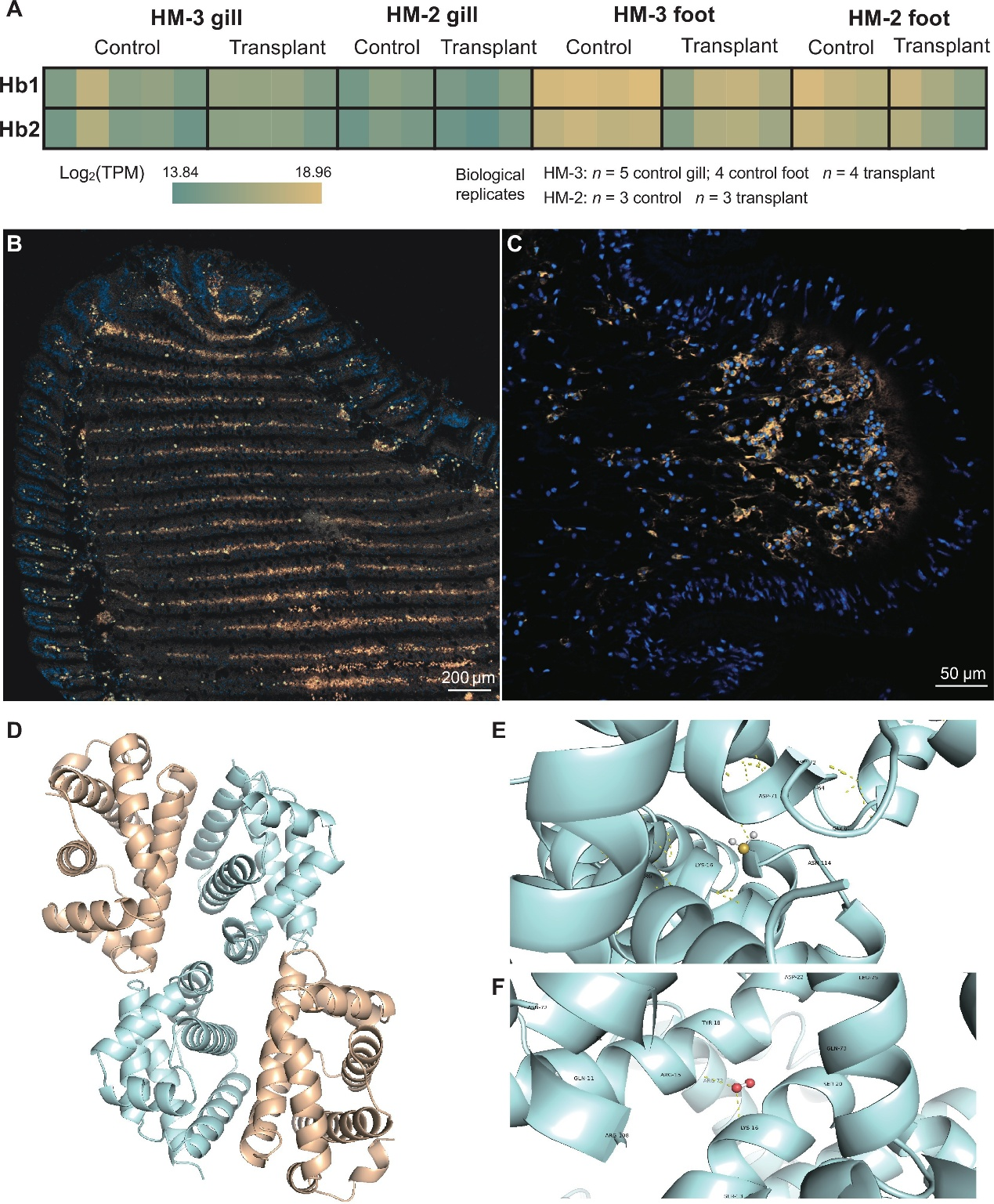
Figure 3. Sulfide binding capability of clam host hemoglobin.
Taken together, this study suggests that A. marissinica and its symbionts employ a multi-layered, tiered adaptation strategy. As environmental stress intensifies, the holobiont can progressively adjust its metabolic activity, symbiont population, and resource allocation, allowing it to maintain physiological function and survival under fluctuating energy supplies. The in situ experimental framework established in this study also provides a new approach for investigating how organisms inhabiting extreme deep-sea environments respond at the molecular and cellular levels to natural environmental change. Cold seeps are important interfaces linking geological processes, biogeochemical cycling, and unique chemosynthetic ecosystems. Understanding how cold seep organisms respond to environmental change is essential for determining how these ecosystems maintain their ecological functions and biodiversity under changing ocean conditions. These findings provide new scientific evidence for understanding the resilience and adaptive capacity of global deep-sea cold seep ecosystems.
The study was jointly conducted by the Guangzhou Marine Laboratory, The Hong Kong University of Science and Technology, Ocean University of China, the Institute of Oceanology, Chinese Academy of Sciences, and the University of Calgary in Canada. The co-corresponding authors of the study are Prof. Peiyuan QIAN, Prof. Jin SUN, and Prof. Casey HUBERT. The co-first authors are Dr. Yi LAN, Dr. Guoyong YAN, and Prof. Hao WANG. The study demonstrates the value of international, multidisciplinary collaboration in advancing research on deep-sea ecosystems and represents an important scientific outcome of the UN Decade Programmes CliMetS and MOCSI, which seek to advance coordinated research, observation, and international collaboration on global methane seeps and deep-sea cold seep systems.
Attachment download:
